The Limits of Current AI: Why Today’s Systems Hit a Ceiling
A grounded guide to the real limits of modern AI—hallucinations, missing world models, and why neurosymbolic systems are the path beyond today’s LLMs.
I spend ₹60,000 a year on AI subscriptions. That’s not the painful part. The painful part is catching myself re-teaching the same business context to a supposedly "smart" assistant every 48 hours, like a broken record stuck on the most expensive loop of my life.
Last quarter, my operations lead handled a client escalation so delicate it could’ve cost us a quarter’s revenue. She remembered every nuance: the pricing sensitivity buried in the contract, the procurement manager’s allergy to technical jargon, the hidden politics between engineering and finance. That single training session paid dividends for six months.
That same week, I asked Claude to draft a follow-up email to the same client. It nailed the tone. Two days later, if I ask it to write another message, same client, same context, same everything.
The response? Blank slate. No memory. No continuity. Nothing. I need to go back to the old chat window and can't in a blank chat. Currently Memory features help but still lack the in-depth nuance
I realized I wasn’t paying for intelligence. I was paying for a brilliant pattern-matcher with severe amnesia. And that amnesia isn’t a bug you can patch. It’s woven into the architecture itself.
This is the ceiling nobody talks about. Not the marketing fluff about "reasoning capabilities." Not the speculation about artificial general intelligence. The real limit is structural: today’s AI can pattern, but it cannot persist. It can generate, but it cannot ground. It can mimic logic, but it cannot hold a stable thought.
For those of us planning to use AI in real businesses with limited resources and zero patience for hype, this distinction matters more than any benchmark. You don’t need another “10x hack.” You need to know exactly where the cliff is so you can stop before you drive off it.
Let me show you what I’ve learned from a year of expensive mistakes, and how to use AI safely within its real limits.
Why Your AI Assistant Forgets Everything (And Always Will)
The first limit is the one you feel in your bones: statelessness.
It’s not that the model is "forgetful" in the human sense. It was never designed to remember. Every time you close a session, the model’s entire understanding of your business evaporates. What remains are weights in a massive statistical model - not memories, just patterns learned from the internet.
Think of it like how most of the older business were built. It starts as a manpower shop: thirty people doing custom client work, all knowledge trapped in heads, nothing written down. Every new project meant reinventing the process. Every client query meant pulling the one expert who knew that specific edge case. It was sustainable at small scale, but exhausting and brittle.
Then we systemized. We built playbooks, templates, decision trees. We moved from manpower to machine—a system that could run without any specific person holding every thread. That system had state: it remembered, it adapted, it persisted.
Modern AI is stuck in the manpower phase. It has no persistent internal model of your clients, your constraints, or your reality. Each prompt is a fresh hire. Each session is training from scratch.
The System 1 Trap
Daniel Kahneman in his brilliant book Thinking Fast and Slow describes two thinking modes. System 1 is fast, intuitive, pattern-driven — the autopilot that recognizes faces and catches a ball. System 2 is slow, deliberate, logical—the quiet work of solving a complex equation or planning a product launch.
LLMs are System 1 engines on steroids. They’re staggering at writing, summarizing, and mimicking tone. But they cannot perform System 2 tasks reliably:
- Multi-step arithmetic
- Causal reasoning ("if X changes, what happens to Y?")
- Planning a project from first principles
- Maintaining consistency across a 100-page document
- Remembering that Client A hates phone calls while Client B expects them
This isn’t a training problem. It’s architectural. As detailed in my earlier guide Neural networks vote on patterns; they don’t manipulate symbols with certainty. When you ask for a project plan, the model doesn’t reason through dependencies. LLM's generates text that looks like a project plan based on thousands of examples it has seen.
I learned this the hard way. I once asked GPT-4 to build a financial model for a business idea. The output looked pristine: clean formatting, industry-standard metrics, even a growth curve that seemed plausible. But the logic connecting churn to customer acquisition cost was broken, statistically plausible but causally nonsense.
It took me three hours to spot the error, and I only caught it because I knew the underlying mechanics. A less technical founder would’ve taken that model to an investor and torched their credibility.
The Photographer’s Eye
My photography hobby taught me about framing. A camera doesn’t interpret a scene; it captures light. The meaning comes from what you include, what you exclude, and what you emphasize. Similarly, LLMs capture statistical patterns. The meaning comes from your prompt, your context, and your interpretation of the output.
But here’s the difference: a photograph is static. It doesn’t forget the sky was blue. An LLM’s “photograph” of your business dissolves the moment you look away. There is no frame that persists.
Why Hallucination Is a Feature, Not a Bug
The second limit is more insidious: confabulation.
A year back, Claude hallucinated a pricing strategy for a client, I didn’t catch it immediately. The email sounded authoritative. It referenced “market benchmarks” and “competitive positioning.” Only after I cross-checked did I realize every data point was fabricated. I had to send a correction email that began with, “I apologize for the misinformation in my previous message.” That’s a trust tax that no business can afford.
This isn’t the model being “dumb.” Hallucination is a mathematical inevitability.
The Statistical Completion Engine
Every LLM output is a probability calculation: “Given this input, what sequence of words is most likely to follow?” When the model is confident i.e. when the pattern is common, it’s accurate. When it’s uncertain i.e. when the topic is niche or novel, it doesn’t say, “I don’t know.” It fills the gap with the most statistically plausible completion.
Psychologists call this confabulation: the brain’s tendency to fill memory gaps with plausible fabrications. Humans do it under pressure. LLMs do it by design.
The Training Box Cliff
The more specialized your domain, the steeper the cliff. LLMs perform brilliantly on common topics (marketing emails, generic sales copy) because their training data is oceans deep. But move to niche B2B procurement workflows, specialized compliance requirements, or your unique product constraints, and you fall off a ledge.
So any time your question or input is outside the training distribution. Rather than AI saying, "I don't know", it will just start inventing. Quietly. Confidently. Dangerously.
No World Model = No Sanity Check
Humans sanity-check automatically. If I told you the sun sets in the north, your mental model of Earth kicks in and flags the error. LLMs have no such model. They don’t maintain object permanence. They can’t verify outputs against a stable representation of reality.
They’re that brilliant intern who answers every question with absolute confidence, even when it's guessing. The problem is, you can’t see when they’re guessing.
** Why Planning and Logic Collapse Under Their Own Weight**
The third limit is the one that breaks workflows: brittle reasoning.
I once tried to use Claude to plan a multi-stage product launch: content calendar, email sequences, webinar logistics, sales follow-up. The first draft looked impressive. Then I noticed the timeline had us sending launch emails two weeks before the product was built. The model had missed a dependency because it wasn’t tracking dependencies, it was generating a plausible-sounding sequence. A lot of such silly errors are fixed with newer models but they do persist.
This is where System 1’s shallowness becomes painful. LLMs can imitate logic but cannot perform it.
The Symbolic Reasoning Gap
True logic requires symbol manipulation: “If A = B and B = C, then A = C.” Neural networks don’t manipulate symbols; they approximate them through pattern voting. This works for simple cases but breaks when chains get long.
Imagine training for a 10k race. You don’t just run fast once. You build consistency: weekly mileage, recovery days, nutrition tracking. That consistency compounds. Now imagine an AI that forgets your training plan every run. It can’t compound because it can’t persist. That’s why long reasoning chains collapse. Each step is a fresh guess, unmoored from the previous step’s logic.
The Entity Tracking Problem
So whenever you take any photo, you look at a scene, you track objects: that’s a tree, that’s a person, they’re moving left. You maintain a stable representation.
LLMs track tokens, not entities. Ask Sora to generate a video of a gymnast, and you may see limbs multiply mid-flip. Ask a text model to write a 50-step process, and by step 30 it’s forgotten step 5. Ask it to handle a client with three stakeholders, and it confuses who wants what.
This is why:
- Legal contracts need human review (entity tracking across clauses)
- Financial models fail silently (causal dependencies drift)
- Project plans look right but aren’t (task sequences are mimicked, not reasoned)
No Causal Engine
Causality is the ability to say, “If we delay the engineering sprint, the launch date moves, which affects the sales team’s Q4 targets.” LLMs don’t reason about cause and effect; they pattern-match descriptions of cause and effect.
They’re like a weather app that shows you beautiful animations of rain but has no model of atmospheric pressure. It looks right until you need to make a decision.
** The Hybrid Path Forward (And Why It Matters Today)**
Here’s where the story shifts from limits to solutions.
The consensus among researchers who built these systems is clear: pure LLMs will never reach true reasoning. Not because they’re poorly trained, but because they’re structurally incomplete.
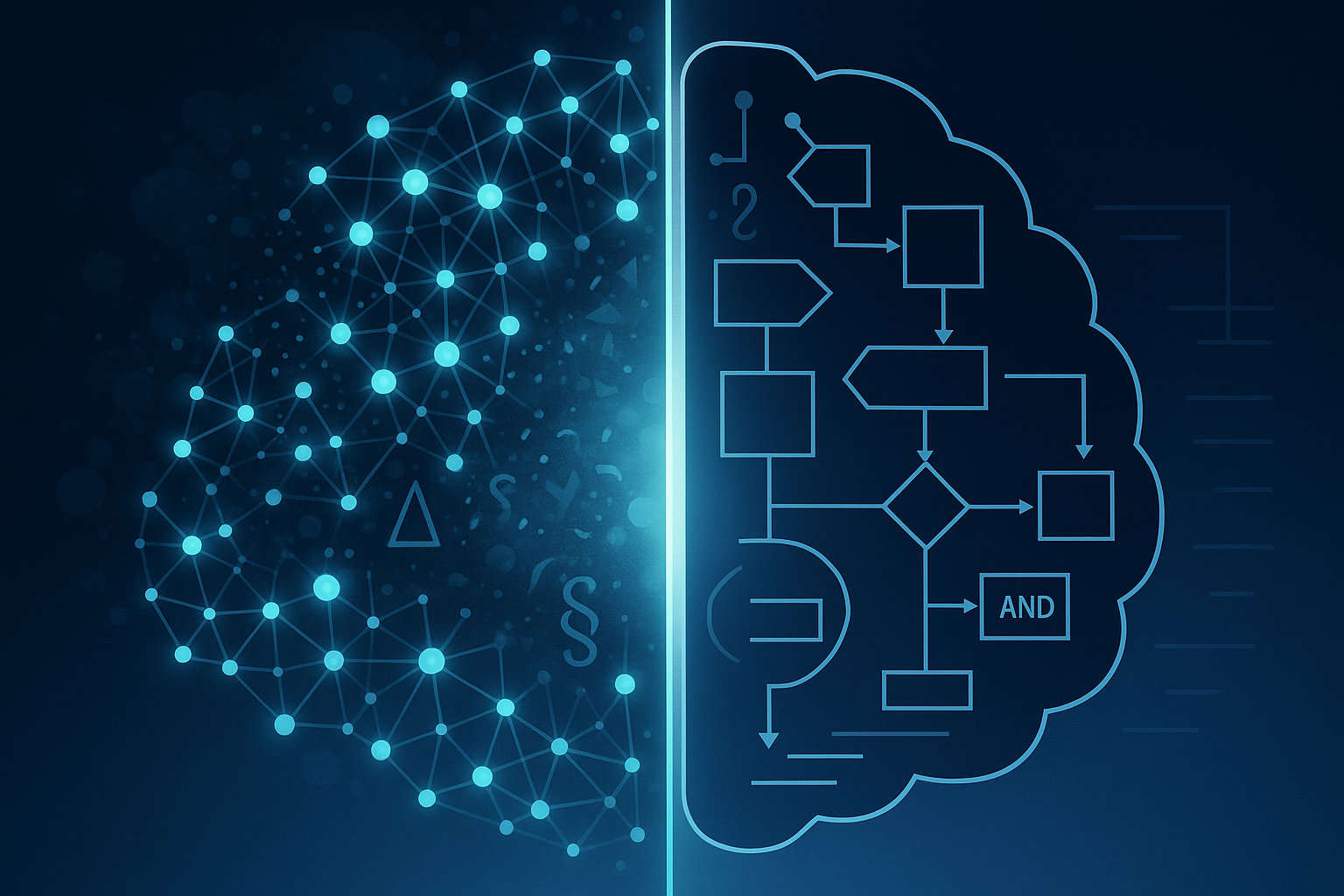
The path forward is neurosymbolic AI: A hybrid of neural networks (System 1) and symbolic logic (System 2). This isn’t theoretical. It’s already working.
The Manpower-to-Machine Evolution
So when a business transitions from a manpower shop to a Systemized Business Process, you didn’t fire everyone and replace them with a spreadsheet. We build a hybrid system: humans for judgment, systems for scale. The humans do what only humans could do i.e. read the room, adapt to nuance, make calls with incomplete data. The system handled the repeatable work.
Neurosymbolic AI follows the same principle:
- Neural Layer: Fast, approximate, pattern-driven (handles language, generates ideas, recognizes contexts)
- Symbolic Layer: Slow, rule-based, validated (checks logic, enforces constraints, runs simulations, maintains consistency)
This is the a proposed architecture that can give us both fluency and reliability.
Proof It Works: AlphaFold
DeepMind’s AlphaFold solved protein folding—a 50-year biology problem, because it was hybrid. It used neural nets for pattern recognition but added explicit geometric constraints and evolutionary rules. It didn’t just predict structures; it validated them against physical laws.
That’s the difference between an LLM writing a plausible scientific paper and a system that can discover a new drug.
OpenAI’s O1 and O3: The Outer Loop
O1 and O3 are the first commercial steps toward neurosymbolic fusion. They generate multiple reasoning chains, evaluate them, and select the best. This “outer loop” is a primitive symbolic system wrapped around a neural core.
It’s still not true reasoning, but it’s progress. The model spends compute thinking during inference, not just generating. It’s like a writer who drafts three outlines before choosing one, rather than blurting the first idea.
Test-Time Compute: Buying Thinking Time
Entrepreneurs understand this: you can’t always think fast. Sometimes you need to step away, run the numbers, check dependencies. O1 does this computationally. It burns more tokens during generation to simulate deliberation.
But, and this is crucial, it still doesn’t have persistent memory. It’s doing System 2 work with System 1 tools. The thinking is real, but temporary.
Fast Weights: The Memory Revolution
Geoffrey Hinton argues that future neural nets need “fast weights” i.e. temporary connections that form quickly, represent short-lived concepts, and decay naturally. This is how your brain holds a phone number for 30 seconds.
Fast weights would give AI object permanence: the ability to remember your Client A’s preferences across sessions, track a project’s evolving constraints, maintain a stable view of your business. Currently, you can imitate such behavior with aid of ChatGPT projects, where it updates certain files when you ask it to remember. However, such tools are using Context Enginnering to replicate such behaviour.
This hasn’t been cracked at scale yet. When it does, the ceiling rises dramatically. Until then, we work with amnesic brilliance.
The Playbook for Building with AI
Understanding these limits isn’t academic, it’s the difference between using AI as a force multiplier and using it as an expensive liability. Here’s what to do now.
Treat AI as a Brilliant Intern, Not a Senior Strategist**
- Your intern is fast, tireless, and writes beautiful prose. But you’d never let them sign a contract, set pricing, or plan a launch solo. Same rule applies.
Build Context Systems Because Amnesia Is Permanent
- You cannot train AI once and delegate forever. You must rebuild its understanding every session.
- Maintain a living context doc with client preferences, product constraints, voice guidelines
- Attach this doc to every prompt (I keep mine in a text expander snippet)
- Update it weekly as rules evolve
- Include edge cases and past failures AS AI learns from patterns, not from your mistakes unless you feed them back in
- You cannot train AI once and delegate forever. You must rebuild its understanding every session.
Apply the Pressure Equation to AI Failures
- The Pressure Equation is P = F/A. When AI failures feel overwhelming, increase the surface area.
- If a hallucination appears catastrophic, frame it as a challenge, write about it. Share your validation workflow. Turn the failure into a story that helps your community. This diffuses the pressure and builds trust.
Build a Simple Validation Layer
- Wherever AI touches critical workflows, add lightweight guardrails and review it personally especially customer facing content, save the pre-AI version
- Always remember: fail small, fail internally, never let hallucinations reach a customer.
Design Workflows That Don’t Require True Reasoning
- If your workflow requires verification, causal chains, or object tracking, pure LLMs will break. So design around that.
- You handle the reasoning. AI handles the pattern generation. This is the hybrid model that works today.
Keep a Human in the Loop for Everything That Matters
Every AI output that affects revenue, customers, or brand gets human eyes. No exceptions. This isn’t inefficiency; it’s insurance.
Document Your AI Experiments
- I keep a simple log: date, task, AI used, result, failure mode. Over last few months, this is what I realised about each AI model
- Claude - Great at Writing, Code Generation and undertaking detailed discussions on a topic
- ChatGPT - Great at Analysis an idea, so use it to analyse anything and share the analysis with other AI models to take the work forward
- Gemini - Great when you have to deal with lot of content. So use to to sumamrize long content into managable chunk that other AI models can use
- xAI - Great if you want to get some insights from Social Media
- Kimi - Great Model to write content and generate slide decks
- Track what works, share the failures, and you’ll have a moat that compounds over time
- I keep a simple log: date, task, AI used, result, failure mode. Over last few months, this is what I realised about each AI model
The Real Limit Isn’t Intelligence—It’s Architecture
I still spend ₹60,000 a year on AI. But now I know exactly what I’m buying: the world’s fastest pattern-matcher, not a reasoning partner.
This shift changed everything. I stopped expecting AI to plan my product roadmap. Instead, I use it to draft multiple ideas based on content I share. I stopped asking it for financial strategy. Instead, I feed it my model and ask it to format it as per my needs
The ceiling is real. But it’s not a wall, it’s a boundary. On one side you have: fluency, creativity, speed. On the other side: logic, persistence, reasoning.
Your job as a founder is to know which side you’re on and build accordingly. Use AI for what it excels at. Protect your business where it breaks. Keep humans in the loop for judgment. Systemize the context so your brilliant intern doesn’t walk in blind every day.
This is what I learnt over the past year using AI in my daily life. It’s not about waiting for the next model to fix everything. It’s about mastering the tools you have today, understand its limits and working within those limits to your advantage.
I am pretty confident that those who win won’t be the ones with the biggest AI budgets. They’ll be the ones who understand the architecture, respect the boundaries, and build systems that turn statelessness into a disciplined workflow.
That’s the path from complexity to clarity. And that’s the only journey that matters.