Compute Wars: Concentration, Cost, and Depreciation
Deep dive into the real economics behind AI boom — from Nvidia’s dominance to trillion-dollar data center buildouts to brutal 3 year depreciation cycles
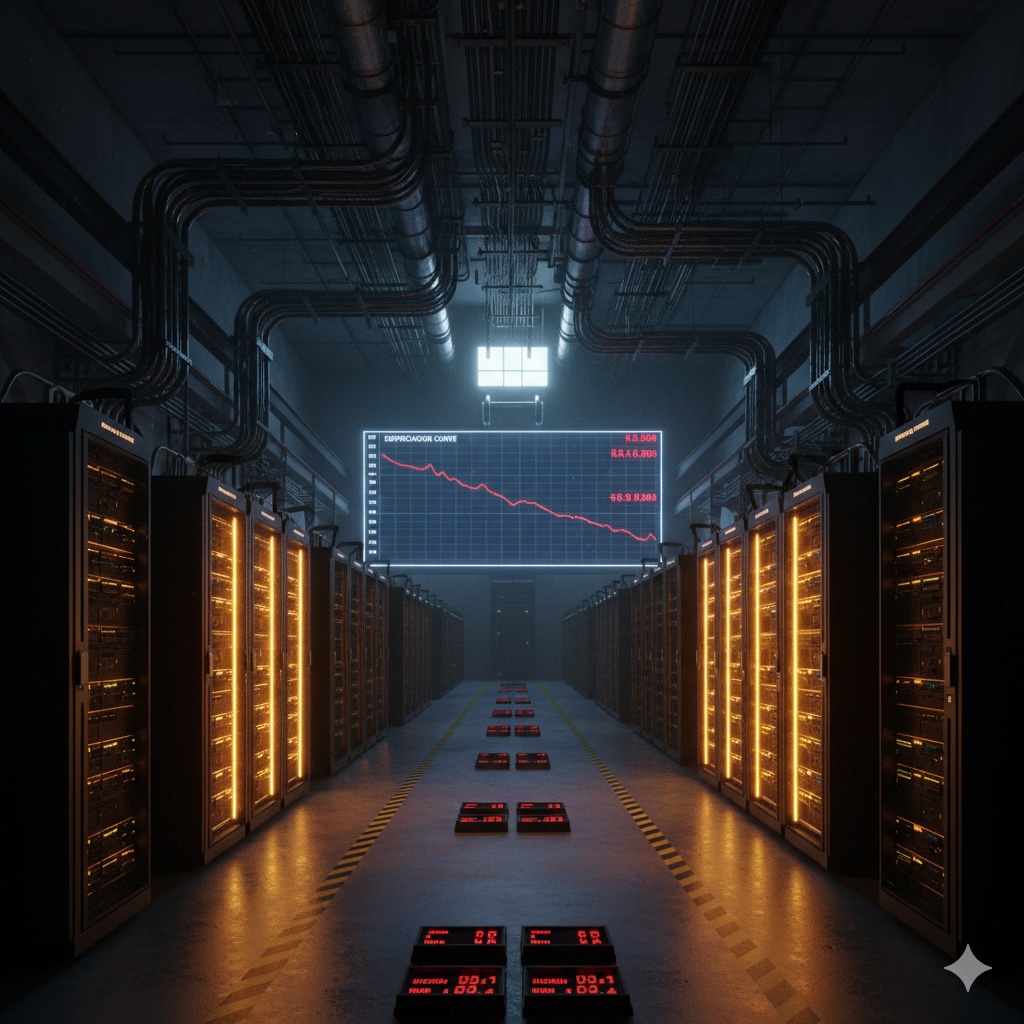
The Big Picture: A historic buildout on fragile ground
If you zoom out, what’s happening right now looks deceptively familiar i.e. a wave of infrastructure spending, executives talking about “the future,” investors circling the next big thing. But the reality underneath feels very different. The last time companies poured money into physical systems at this pace, they were laying tracks, digging tunnels, or stringing cables across continents. Those investments endured for decades.
Today, the world’s most profitable software companies are pouring tens of billions into boxes that age like fruit on a warm day. The assets don’t just lose accounting value; they lose competitive value. A rack of GPUs that looks impressive today might feel embarrassingly slow by the time your next planning cycle comes around.
The deeper discomfort is this: the buildout isn’t optional. Every major firm understands that pulling back invites irrelevance. And so they build while knowing the ground under them is constantly shifting.
Key Takeaway:
You’re watching companies replace durable industrial infrastructure with fast-decaying compute. Don’t confuse scale with stability; this entire buildout sits on hardware cycles that punish hesitation and reward those willing to reinvest faster than they’re comfortable with.
Concentration: Nvidia and why supplier risk matters
Every industry has chokepoints, but few chokepoints are this absolute. Nvidia didn’t just become the default choice; it became the gravitational center of the entire AI universe. Almost every lab, startup, cloud provider, or national strategy bends around its roadmap.
This isn’t because the alternatives are terrible, it’s because the ecosystem around CUDA is so deep, so mature, and so optimized that shifting away isn’t a technical decision; it’s an organisational rewiring. And Nvidia knows it. Their pricing power reflects that. Their cadence reflects that. Even their investments, the way they place strategic bets inside their biggest customers reflect that.
In practical terms, a company that relies on Nvidia isn’t just relying on chips. It’s relying on Nvidia’s supply chain, political luck, export regimes, and the pace at which one company decides to innovate.
Key Takeaway:
Nvidia’s dominance isn’t a market quirk — it’s a structural reality. Treating them as “just another supplier” is a mistake. Your risk isn’t about chips going out of stock; it’s about having a single point of dependency in the most important layer of your stack.
Financial plumbing: circular deals and hidden leverage
If you peel back the engineering narratives, you find a financial system quietly doing contortions to keep the whole thing running. Suppliers funding customers who buy more from those suppliers. Private credit vehicles absorbing risks that hyperscalers refuse to carry on their own books. Special Purpose Vehicles acting as holding tanks for assets nobody wants to depreciate internally.
It’s clever, sure. But clever doesn’t mean stable. These mechanisms work when demand grows at the rate everyone expects. They don’t work when growth pauses or when utilization misses the glossy pitches. And because the assets lose value so quickly, a single bad quarter can tip an SPV into covenants that trigger forced unwinding.
The irony is that the industry has created the form of resilience i.e. shared risk, but not the substance. The real risk just hides one layer deeper.
Key Takeaway:
Follow the cash flow, not the press releases. The compute boom is sustained by financing structures that work until they don’t. Whenever you see an SPV or vendor-financed deal, assume the risk sits with whoever has the least room to absorb a bad cycle.
Depreciation: the three-to-five year trap
This is the part that rarely gets discussed in boardrooms because it forces uncomfortable math. The hardware cycle is unforgiving. A GPU fleet you proudly deploy today will still run in five years, but in competitive terms, it may already be obsolete by year three.
Unlike fiber or rail, compute doesn’t accumulate value; it evaporates in relative performance. Every cycle accelerates the next. A company that buys hardware is essentially agreeing to keep rebuying hardware forever, or get stuck with an uncompetitive fleet while someone else leaps ahead.
And once you accept that reality, the business model shifts. You’re no longer building “infrastructure.” You’re renting a temporary advantage.
Key Takeaway:
Don’t romanticize ownership. AI hardware behaves less like a long-term asset and more like short-lived inventory. Every purchase commits you to the next purchase, and the next after that.
The inference economy: OpEx is the long game
People love talking about training costs, the big, spectacular number, the media-friendly storyline. But in any sustained AI business, training is the opening act. The real expense is inference.
Every query your users make triggers a cost. Every new feature you launch multiplies that cost. And unlike software, where marginal cost approaches zero, AI has a stubborn floor: you pay for every token, every calculation, every millisecond of GPU time.
Once you see this clearly, the economics feel different. You don’t need a big model for every task. You don’t need frontier capability for routine work. And you certainly shouldn’t build products where cost-per-query quietly eats your margin from the inside.
The firms that survive will treat inference like COGS, not “infrastructure.”
Key Takeaway:
Inference, not training, determines long-term survivability. If you don’t know your cost-per-query today, you don’t actually know whether your AI features make money or burn it.
Power: the hard physical constraint
Silicon used to be the bottleneck. Now it’s electricity. No matter how much money the industry pours into GPUs, nothing moves if you can’t plug them in. And grids don’t scale at the speed of venture money or press cycles.
This is why the conversation quietly shifted from “How do we get more chips?” to “Where do we get the gigawatts?” Companies are signing multi-decade power purchase agreements, scouting regions with surplus capacity, and even exploring nuclear options, not because it’s exciting, but because the alternative is watching billions of dollars of hardware sit idle.
The physical world is pushing back, and it doesn’t care about roadmaps.
Key Takeaway:
Compute ambition collapses without power planning. Treat energy availability as a first-order strategic decision and not an afterthought once the hardware arrives.
Geopolitics: Sovereign compute and National strategies
No country wants to be dependent on a foreign power for compute the same way they once feared dependence on oil. The global mood has shifted: compute is power, and nations are scrambling to claim a piece of it.
So you get “Sovereign AI” projects everywhere — some strategic, some political, some symbolic. Nations want local data centers, local models, local talent. But building compute clusters doesn’t guarantee demand, and a lot of these plans risk becoming quiet oversupply projects, stranded without sustained workloads.
Yet the direction is clear: AI is now part of national industrial policy. And the firms at the center of this ecosystem aren’t simply tech vendors,they’re geopolitical actors.
Key Takeaway:
Sovereign AI efforts reshape markets, but not always rationally. They create opportunity, distortion, and new dependencies,often all at once.
Tactical playbook: what you must do
In a world where compute costs balloon, hardware ages fast, power becomes a bottleneck, and supplier concentration shapes your options, the only strategy that works is deliberate, grounded discipline.
You diversify hardware not because it’s convenient, but because dependence on a single vendor is a strategic trap. You track cost-per-query because margins live or die on that number. You assume 3–5 year refresh cycles because pretending otherwise is self-deception. You plan for power early because electricity is now a gating factor. And you interrogate every financing structure, because half the stability you see is engineered, not real.
The leaders who win this cycle will be those who understand the terrain, not just the technology.
Key Takeaway:
Effective strategy in the compute era is about discipline i.e. diversified hardware, ruthless cost visibility, short asset cycles, early energy planning, and skepticism toward engineered financial stability.
Key lessons
The AI industry has drifted far from its software origins. What used to be margin-rich, asset-light, and infinitely scalable is now capital-intensive, power-dependent, and constrained by depreciation curves. The winners won’t be the loudest or the fastest — they will be the ones who understand that compute is no longer a tool. It’s the terrain itself.
Everything from CapEx decisions to vendor choices to energy strategy now defines how far a company can move and how long it can stay competitive. And because hardware keeps shifting under our feet, the real mastery isn’t in picking the perfect strategy — it’s in staying flexible enough to survive the next cycle.
Key Takeaway:
The compute wars reward clarity, not enthusiasm. Understand your dependencies, model your costs honestly, refresh your assets deliberately, and plan for power before you plan for scale.